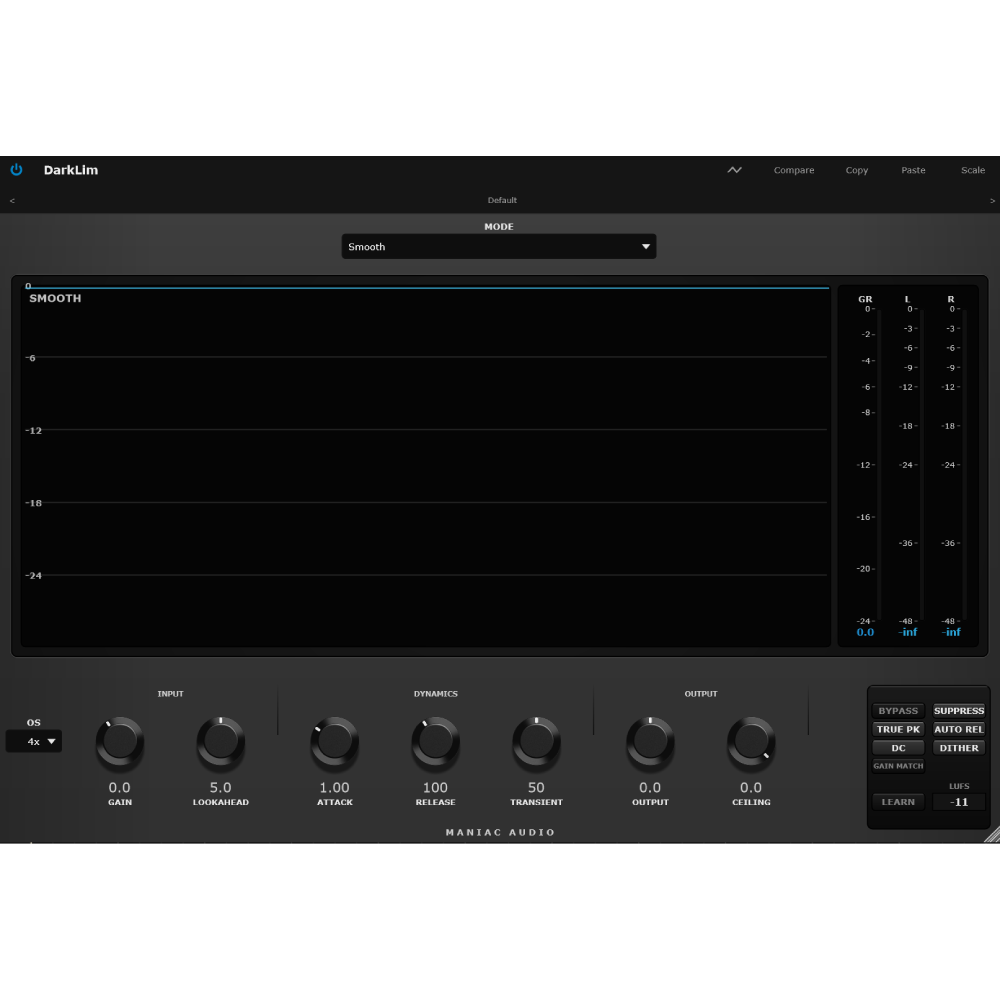
DarkLim
A true-peak brickwall limiter for maximizing loudness on masters and buses without clipping — the modern “transparent maximizer” class of limiter. DarkLim combines oversampled true-peak detection, multiple character modes, and a LUFS learn/match workflow, so you can push level confidently while staying within a chosen ceiling.
Mode + oversampling (top)
MODE (Linear / Smooth / Aggressive / Punch / Warm / Transparent) — Limiter character/shape. Ranges from clean and transparent to aggressive/colored, with Punch preserving transients and Warm adding subtle saturation.
OS (1x / 2x / 4x / 8x) — Anti-aliasing oversampling for the limiter and true-peak detection. Default 4x.
Input
GAIN (−24…+40 dB) — Input gain — how hard you drive the signal into the limiter. More gain = more limiting/loudness.
LOOKAHEAD (0…10 ms) — Lets the limiter “see” peaks before they arrive so it can catch them cleanly without distortion. Default 5 ms.
Dynamics
ATTACK (0.01…20 ms) — How fast the limiter clamps peaks. Default 1 ms.
RELEASE (10…1000 ms) — How fast gain recovers after limiting. Default 100 ms.
TRANSIENT (0…100%) — Balances transient preservation vs. loudness — higher keeps punch/attack, lower clamps harder for maximum level.
Output
OUTPUT (−24…+24 dB) — Output gain trim after limiting.
CEILING (−24…0 dB) — The brickwall ceiling — the limiter guarantees the output never exceeds this level. Typically set to −1 to −0.3 dBTP for safe masters.
Toggle controls
BYPASS — Bypass the limiter.
SUPPRESS (overshoot suppression) — Extra stage that catches any peaks that slip past, guaranteeing the ceiling is never exceeded.
TRUE PK — Enables inter-sample (true-peak) detection so the limiter catches peaks that occur between samples — essential for streaming-safe masters.
AUTO REL — Program-dependent automatic release.
DC — DC offset filter.
DITHER — Adds dither on the output for clean bit-depth reduction.
LUFS loudness matching
LUFS (editable value) — Type your target integrated loudness (e.g. −11, −14 for streaming).
LEARN — Press LEARN to measure the program’s current loudness, then it adjusts gain to hit your LUFS target.
Metering
GR / L / R meters — Gain reduction plus left/right output level metering, with the graph display showing limiting activity over time.
Reviews
There are no reviews yet.