DarkGale
A model-based compressor with the soul of 30 classic units in one box. DarkGale lets you pick a topology and a voicing, then shape everything by hand — threshold, ratio, knee, attack and release are all live, while each model only biases the engine toward its real hardware character. Behind it sits an ADAA harmonic stage, dual transformer iron, a 6-band analog-matched EQ routable three ways, and program-dependent adaptive timing. Clean reference glue, all-buttons FET energy, opto smoothness, Fairchild vari-mu lushness, diode-bridge grit — it’s all here, fully editable.
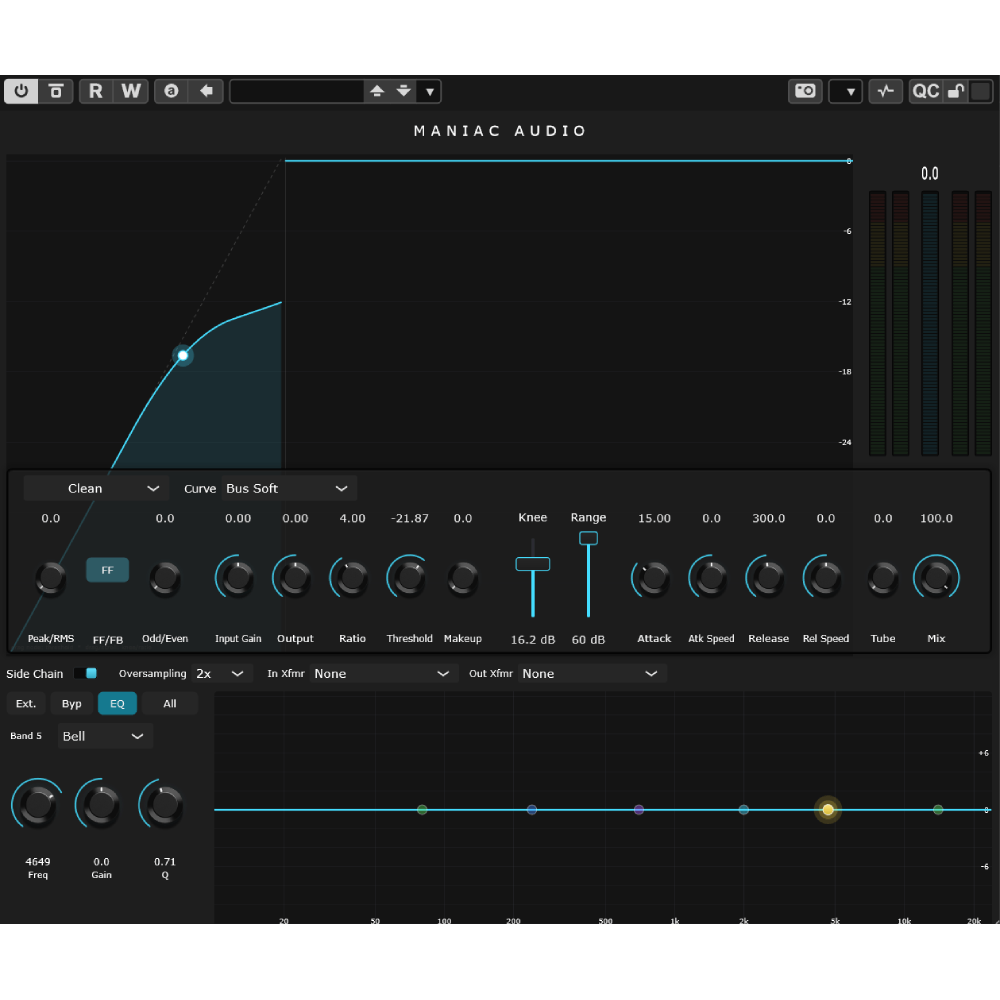
Main panel — compression
- MODEL (combobox, 30 models) — The heart of DarkGale. Each model loads a different DSP topology (Clean / FET / Opto / VCA / Vari-Mu / Diode / Feedback Bus) plus its own harmonic voicing. Picks like Falcon (1176 all-buttons), Lumen (LA-2A), Lumen Mk II (LA-3A), Monarch (Fairchild 670), Quartz (SSL bus glue), Foundry (Neve 2254 diode) and Apex (surgical brickwall). The model is a starting point, not a lock — every knob stays free.
- THRESHOLD (−60…0 dB) — Where compression begins.
- RATIO (1:1…20:1) — Compression amount. Vari-mu models bend this progressively harder as gain reduction increases, like the real iron.
- KNEE (0…24 dB) — Soft-to-hard knee width. Opto models widen it naturally; turn it down for snappier, more aggressive onset.
- ATTACK (0.05…250 ms) — How fast the compressor grabs. Each model maps this into its authentic hardware range.
- RELEASE (5…2500 ms) — Recovery time, with multi-stage program-dependent behaviour on opto/vari-mu models.
- MAKEUP / OUTPUT — Makeup gain and final post-everything output trim (±12 dB).
- CURVE (FET / Opto / Vari-Mu / VCA Hard / Bus Soft) — Overrides the knee/ratio curve shape independently of the model.
- FF / FB — Detector topology. FB (feedback) = smoother vintage character; FF (feedforward) = tighter, more transparent transient catch.
Tone & character
- MIX (0…100%) — Parallel (dry/wet) compression.
- INPUT GAIN (−40…+40 dB) — Pre-compressor drive trim.
- TUBE — 12AX7 valve saturation amount.
- PEAK / RMS — Blends the detector between fast peak-hold and smooth RMS sensing.
- ODD / EVEN — Tilts the harmonic content of the saturation stage.
- ATK SPEED / REL SPEED (±100%) — Fine offset on top of the model’s timing for punch/tightness without leaving the model.
EQ — one display, three destinations
A single 6-band parametric EQ (HP / L.Shelf / 2× Peak / H.Shelf / LP) with EQ ROUTING:
- Detection — Sidechain EQ: shapes what the detector hears so the comp reacts more/less to chosen frequencies.
- Audio — Output EQ: post-compression tone shaping on the signal itself.
- Both — does both at once.
Drag nodes (freq X / gain Y), mouse-wheel for Q, right-click to toggle a band. Stereo or M/S mode with adjustable MS linking, per-band placement (Stereo/Mid/Side/L/R) and transient/sustain split (All/Trans/Sus). Coefficients are analog-matched (Zölzer DAFX) for smooth, gain-accurate, analog-phase response. There’s also a dedicated Sidechain HPF (20…500 Hz) to stop bass from pumping the compressor, and a separate saturation-emphasis EQ stage.
Iron & saturation
- IN XFMR / OUT XFMR (combobox, 20 transformer models each) — Independent input and output transformer emulation (None, Vintage A/B, Modern Clean, British 60s, German Tube, American Iron, Neve-style bus, amorphous Hi-Fi/Tube and more). Default None keeps the transformerless sound.
Detection & metering
Lookahead (up to 10 ms), true-peak detection, and hold are available for precise transient control. The lower zone hosts a background-thread real-time spectrum analyzer drawn behind the EQ graph.
Oversampling
- Off / 2x / 4x / 8x (combobox) — FIR equiripple anti-aliasing on the saturation chain only, so attack/release ballistics stay correct regardless of OS factor. Integer-latency reporting keeps host PDC sample-accurate.
Reviews
There are no reviews yet.